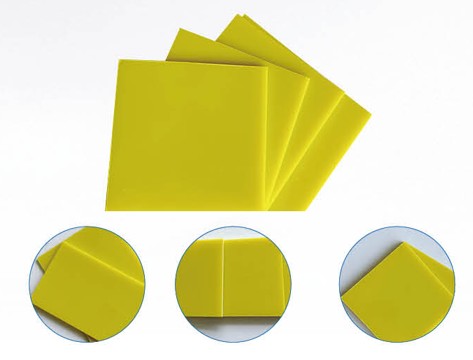
FR-4 and G-10 are the two most widely used epoxy glass cloth laminates in the electrical insulation industry. Both are made by hot-pressing woven E-glass cloth impregnated with epoxy resin, both are strong, and both insulate well. To most buyers they look almost identical. So what is the real difference, and how do you choose?
The Key Difference: Flame Retardancy
The single most important difference is flame retardancy. FR-4 is flame-retardant and meets the UL94 V-0 standard, meaning it self-extinguishes once the flame source is removed. Standard G-10 is not flame-retardant. In fact, FR-4 was originally developed as the flame-retardant version of G-10 — the "FR" literally stands for "Flame Retardant."
When to Choose FR-4
Choose FR-4 whenever fire-safety standards apply. This includes printed circuit boards (PCBs), electrical enclosures, switchgear, transformers and almost all modern electronic equipment. Because of its UL94 V-0 rating, FR-4 is the global default for electrical insulation and is required by most international safety certifications.
When to Choose G-10
Choose G-10 when you need the absolute highest mechanical strength and fire safety is not a requirement. Typical uses include structural insulators, cryogenic supports, knife handle liners and precision machined parts. Because G-10 is not loaded with flame-retardant additives, it can offer slightly higher mechanical strength and is often preferred for demanding structural applications.
Quick Comparison
The Bottom Line
If fire safety matters or you simply aren't sure, FR-4 is the safer general-purpose choice. If you need maximum strength for a non-fire-rated structural component, G-10 is ideal. As a factory-direct manufacturer, we supply both FR-4 and G-10 from 0.5 mm to 100 mm thick, cut to your exact size, with reliable export to the USA, Mexico, Brazil and Europe.
Need a quote or a free sample? Contact our technical team and we'll help you select the right grade for your application.